Well, folks, it's about time I posted again. This time I would like to cover the Dvorak Keyboard layout. This layout is a re-mapping of the keys on the keyboard that was designed to improve typing efficiency. It accomplishes this in several ways, the primary way being the strategic placement of letters of high occurrence in the home row and under the strongest fingers and furthermore increased alternation of hands, which increases speed and reduces typing fatigue. It is also easier to learn, and having practiced now for a few hours, I have already begun to instinctively press the Dvorak key correctly. Nevertheless, I will be practicing for some time before I will be truly proficient.
In any case, try it out - you might like it!
Registered Linux User #370740 (http://counter.li.org)


OpenOffice.org 3.0
So the day we have been waiting for has finally come! OpenOffice.org 3.0 was just released this week, taking down their website with a staggering number of hits. Having jumped into the picture and downloaded the Linux, Mac, and Windows versions to deploy in my very diverse home lab, I can say that OpenOffice has provided the much-anticipated 3.0 release right on target. The most useful feature for me is the compatibility with the Office Open XML format, used in Microsoft's Office 2007 & 2008. While Extensions were also noted as a major feature of this new release, I have yet to experience them to their full potential, either as a user or as a developer.
One interesting comment concerning OpenOffice, and also along the lines of the poverty discussion that I posted yesterday, is its adoption by organizations in developing countries. The Brazilian government was among the first to adopt OpenOffice as its document productivity standard, making the switch to OpenOffice (Banco do Brasil: http://www.tmcnet.com/usubmit/2006/05/30/1662778.htm; Government: http://www.datamanager.it/articoli.php?visibile=1&idricercato=17447). This is another aspect of computing that benefits the developing world, enabling these countries and societies to, for the cost of education on how to use the software, participate in the sharing of information, both from the receiving and the sending ends of the communication process.
Registered Linux User #370740 (http://counter.li.org)
On Poverty and Computing
Today is a day in which bloggers everywhere are invited to blog about poverty. Poverty is a global humanitarian issue, affecting over a billion people. In my recent coursework, I studied globalization and its effects on various components of society, including poverty. One problem with globalization, as practiced in many countries, is that the influx of money is not distributed evenly or fairly within that society. The money tends to stay "on top" in the hands of the rich, while the poor remain poor, and even become relatively "poorer" due to the increase in wealthiness of the rich. Joseph Stiglitz in Making Globalization Work uses the phrase, "rich countries with poor people" to illustrate this reality.
What about computing? What can we do in the computing world to help alleviate the poverty that exists in the world at large? We have seen the One Laptop Per Child (OLPC) project, the XO netbook, and other very cheap computing devices that, coupled with Internet access, provide the wealth of information that is readily available on the internet to the new computer user. There is an obstacle of education, because many of the targeted users of these devices are next to illiterate and would need to learn basic written language in order to make use of the Internet. Becoming accustomed to using the technology would be another aspect slowing the adoption of Internet access in the developing world. Another key point to consider is that we, as people living in the developed countries, have had access to multiple Internet-enabled devices, including a variety of handheld devices in addition to the primary desktop or laptop computer. We have been using the Internet to facilitate functions including communication (via e-mail or instant message), banking, shopping, and even running an entire small business! Individuals in the less developed countries of the world participate in fewer of these functions, and without the aid of the Internet, so it would take a dramatic change in lifestyle for them to adopt the technology like the rest of us.
It is critical to note here that it is not a question of "us versus them" or that "they" need become like "us." Rather, it is to bridge the gap between rich and poor, to provide a more equitable quality of living for all people, with respect to their region. The point is to avoid the feudal-like society with throngs of people who belong to the land that they work and the man that owns it. Such a change will require those who are in power, those who have "made it" in their society to reach out to those who have fallen by the wayside, providing education even in the most informal sense of "education" and resources for them to obtain more formal education and secure legitimate work in the economy, whatever it may be. This work will then enable those inviduals to possess what they might, and obtain what services they might, to improve their quality of life.
One place computing can help is in the market of web design - the process is relatively easy to learn, although it is not as practical and tangible as the work of an automobile mechanic or someone in industrial production, which are occupations frequently chosen by some people trying to work their way out of poverty. Rather, one need only understand a bit about (1) how a web hosting service is chosen, and how to configure that service; (2) principles of graphic design; (3) typical web technologies of today, particularly XHTML, CSS, and JavaScript, PHP or ASP.NET, and when one really becomes adventurous, the infamous but ever-more prevalent Database, be it MySQL, PostgreSQL, or Microsoft's SQL Server. With these limited skills, someone with Internet access can create his own business, solicit clients from his friends and their friends, and really build up the art, from the dust of poverty to the mainstream culture quite rapidly compared to other skilled occupations. The only problem with doing web design in a developing country is that very few of the locals will have access to or rely upon the Internet as a local resource, if at all, but an agency in a developed country may provide the ability for web developers in developing countries to provide their services and receive just compensation for them, lifting these individuals out of poverty and improving the quality of life for them, their families, and their neighbors.
The information age has very tangible benefits for people everywhere, but as demonstrated above, not every existing society can benefit from computing technology in the same manner as the others, although it could help many societies in dramatic ways to help alleviate poverty worldwide.
Registered Linux User #370740 (http://counter.li.org)
Slackware v?
I fell in love with Slackware as soon as I started to use it, frustrations with building from source aside, it is a very streamlined system. With the recent release of v12.1 I think I will give it another shot; I'm still running 11.0 with a (more) recent kernel, and many system library updates, as needed as dependencies for other programs... the funniest of all was upgrading flex, a text parser, because I had the 1997 version on my machine and pidgin wanted one from a few months ago or sooner - so I went to grab those packages and successfully built pidgin after having updated that dependency.
Another woe is using KDE 3.5.7 when 4.1 is almost here... it seems to be maturing nicely; I used an early beta via the OpenSUSE live disc but that was a very unpolished build... I have also used a more recent 4.0 build (or a 4.1 beta?) on Ubuntu, which is better but still a work in progress - 4.1 seems like it will finally be worth using, and they just announced the Cube desktop switcher, KDE native!
Another interest I have is running KDE on Windows and Mac - I use all three platforms daily (both Windows XP and Vista) and it would be nice to merge the interfaces together somewhat... hitting the key to the left of the spacebar as the primary modifier doesn't work so well in windows or linux... :) (CTRL(alt!) vs COMMAND key mappings). Plus, Amarok is undefeated in my eyes and I'm still using a very old version of it - can't wait for latest stable!
Another thought I have is to maybe switch over to a Slackware derivative with package management (like KateOS, which I reviewed a while back). We shall see... Always backup data and profile settings :)
Registered Linux User #370740 (http://counter.li.org)
Slax 6
I have always appreciated the simplicity of Slax, and version 6 was long-awaited. I didn't try it out initially, for various reasons, but one of my friends had a hard drive-related problem and couldn't boot - a typical usage for a live CD with the simplicity and agility of Slax. So I downloaded and burned the 189MB ISO and fired it up in the broken machine.
I chose the copy-to-ram method from the graphical boot menu (an upgrade from the v5.8 text-based boot-loader), and a few minutes later the CD came out and I was looking at a full-blown KDE session with wireless networking already enabled and connected! The hardware support was incredible. I always had to tweak my xorg.conf and various network-related config files to get things to run nicely, but v6 runs like a dream!
If you're not already familiar with the Slax project, it is an implementation of the developer's live-CD library and utilities - another project well worth the research. For more information, check out Distrowatch's Slax page.
Registered Linux User #370740 (http://counter.li.org)
Subscribe to:
Posts (Atom)

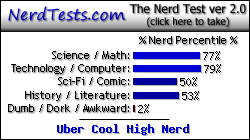
Nerd Test
v1.0:
 |
v2.0:
|
Bloggers' Rights