Followup on Moodle

The Moodle project, in which I participated this past semester, was a success, though not complete.

The reality is that, in Open Source, each contribution, though perhaps partial, helps the community at large. It is important that each code, technical, or design contribution be accompanied by appropriate documentation that explains its foundations and motivation, as well as sufficient technical documentation as to its specific functioning. Our project included just that, a 25-page report detailing our preliminary efforts, the tools we used, our end product, its flaws, and advice for improvements.

More specifically, we completed a fairly complete DB2 interface to echo those of MySQL, PostgreSQL and others already supported in the 1.9.x database scheme (the v2.0 scheme is different). We also completed some preliminary testing that helped us to further complete our implementation. The next team to take on this project will have their work cut out for them to guarantee that Moodle works fully on DB2.

Please drop any questions in the comment area below. Thanks!

Registered Linux User #370740 (http://counter.li.org)

Re: Is social media going to kill SEO?

My apologies to the anonymous visitor whose off-topic comment I initially rejected. Let me answer your question.

By social media, let me define it by example to be services like Google Wave, Facebook, Orkut, Linkedin, Twitter, Digg, Reddit, Slashdot, and others. Let me consider blogs separately from these.

By SEO, we mean Search Engine Optimization, or the art and science (yes, both) of crafting ones content and metadata in a search-engine friendly way so that one's website is most accurately represented (not misrepresented) and, thus, can be found by those likely visitors who, in the absence of good SEO, would not have found the site.

SEO works brilliantly on static websites (those composed of .html pages, which are updated "manually" or with the help of half-way automated tools). The content is prepared, so it is easy to provide SEO for that content at the time of preparation. For dynamic content, on the other hand, while it is not difficult to provide SEO at the time of the content's creation, it is unpredictable how to access the content (a permanent link) or it is the mere dynamic nature that can result in omissions of content (content was posted and then changed before it could be indexed), or the information on the site is dependent, somehow, upon various characteristics of the viewer, especially geography - search engines must be able to pose as each combination of characteristics the site responds to and thereby make a complete index of the content.

To this end, search engines have now adopted the Sitemap idea, which provides (possibly dynamically) a list of the pages on a site, along with how frequently they are updated, in an easy-to-parse and flexible XML format (see http://www.sitemaps.org/). This helps search engines to find the pages that are generated dynamically, and to which there may not be obvious links elsewhere on the site.

Social media (let's take Twitter, for example) can only kill SEO if it is the only place that content is created on the web. This is because it would be exclusively within the control of the social media service to index and provide searchability of its collective content (within appropriate access permissions). Twitter and Facebook news feeds are "live," meaning that as soon as matching or "relevant" content is available within the system, it will be added to your feed, as you watch. This is a nightmare for public search engines, but within a corporation, especially with a cloud-based functional engine driving it (like MapReduce), queries can be performed on practically up-to-the-second fresh content. In this regard, SEO would not be needed.

So it seems that the art and science of optimizing the content available on a website in order to ensure that search engines out there can detect and index that content for the public to search is far from endangered, but rather will remain in demand for quite some time. SEO, as a business or professional service will certainly continue to change its practice to accommodate new technology and maintain its place in the midst of the automated tools that support it, but SEO is most certainly not going to be killed by social media.

Registered Linux User #370740 (http://counter.li.org)

Society of Women Engineers

This weekend is the Society of Women Engineers National Conference. It happens to be in my hometown. It is shockingly different to attend an incredibly technical event and be completely surrounded by women - we are talking a 95% constitution of those human beings producing more estrogen than testosterone. This is the complementary circumstance to that which I experience daily - namely, a vast majority of men at incredibly technical functions, especially Engineering classes.

The purpose of the Society of Women Engineers is best stated by the expanded title "Society for the Advancement of Women in Engineering" - after all, I am a national member, and I am male. Just as the National Society of Black Engineers encompasses all who promote the advancement of engineers of African descent, and the Society of Hispanic Professional Engineers and the Society of Mexican American Engineers and Scientists similarly encourage all who promote those who fall under those specific ethnic categories to succeed in Engineering, SWE is comprised of individuals who encourage women to excel and advance in the profession.

I was given the tag "I blog about SWE" and since that was not the case previously, it is now justified! Many women helped to pioneer earth-shattering breakthroughs in various engineering and technical disciplines, and their successes proved that it is not necessarily a male-dominated field, but it is so de facto.

Go SWE!

Registered Linux User #370740 (http://counter.li.org)

Contributing to Open Source

This semester, I attack my senior project in Computer Science. We have been given the opportunity to contribute to Open Source as our senior project; of course, our experience will be well documented.

My team of four has taken on an altogether greater opportunity to work with IBM to encourage compatibility for Moodle with IBM's DB2 relational database management system (RDBMS). Moodle is an online course management system, written in PHP. Presently, Moodle's code supports Oracle, MS SQL, MySQL, and PostgreSQL. Their framework is flexible enough to allow an extension to support DB2, so that is our endeavor.

We have found, so far, that it is not a trivial task to work together on such a project; we are presently one month into the project and are just finishing up our preliminary research, defining the scope of our contributions, and establishing our development and testing environments.

And so it begins - I transition from just using Open Source to contributing to it!

Registered Linux User #370740 (http://counter.li.org)

WikiTrust - Accountability in the Open Encyclopedia

This article from MIT's Technology Review gives a succinct overview of the WikiTrust project, an effort at the University of California at Santa Cruz (UCSC) to add accountability to open knowledge bases, like Wikipedia, in order to make the content contained therein more useful. The project takes into consideration several aspects of each author's credentials and how their contributions are received by the editing community on that knowledge base; color coding is used for easy identification of the reliability indices that are provided.

This sort of construct, that requires human intervention to certify the authenticity or reliability of other humans on particular topics, is badly needed in most parts of the Internet - browsers are, at the present time, left mostly to their own devices to prove the validity of content they see online, conducting their own investigation of related material and researching the backgrounds of each "author" of online content.

This issue (of identifying experts) is, in fact, opposed to some aspects of the online privacy and anonymity movements for obvious reasons - the identity of the author must be guaranteed in order to certify that the information provided is valid; someone may simply impersonate a reputable expert in a field, posting erroneous information in their trusted name. This can only be avoided by using the web of trust identity system (thawte, wikipedia), which currently exists, but is not widely used. Web of trust works by providing a framework and workflow by which individuals may certify the identity of others, and through the web, someone may be trusted through any number of first-hand trusted connections. The framework, at its core, relies on digital cryptography. A wiki-like environment using the web of trust for certification should present some sort of a revision hash, uniquely identifying a particular revision, and experts trusted through the web of trust should then cryptographically sign that revision only, certifying that the contents of the article through that revision are accurate, and then be notified to likewise certify subsequent revisions. The more trusted signatures a document has, the more reliable it can be said to be, without further investigation.

These systems, however, require that users at large become familiar with their high-level architecture, and understand the implications of various actions taken with respect to them. This education phase is necessary to understand fully how to operate in the information age. Security and identity online can be compared to rudimentary physical security and human legal identity - it is highly uncommon that individuals broadcast their social security numbers or leave their vehicles or homes unlocked when leaving them. Likewise, it ought to be uncommon for Internet users to leave their sessions unattended or unsecured. This, however, requires that users understand the workings of this more complex system; a home or auto lock is quite simple to understand and use, still without knowing its inner workings, but the equivalent constructs in the computing world are a bit more difficult to understand and use.

Registered Linux User #370740 (http://counter.li.org)

Facebook

Paul Nguyen's Facebook profile

Nerd Test

v1.0:
I am nerdier than 94% of all people. Are you a nerd? Click here to take the Nerd Test, get nerdy images and jokes, and talk on the nerd forum!
v2.0:
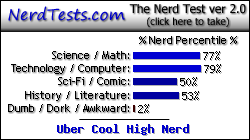
NerdTests.com says I'm an Uber Cool High Nerd.  Click here to take the Nerd Test, get nerdy images and jokes, and write on the nerd forum!