Slax 7

My favorite rescue Linux distribution just released some major news!

Thomas M of the Slax project (really the sole maintainer) sent out the following email to a normally very quiet mailing list:

I'm happy to announce that Slax got financial support and I'm now working on a next major update, Slax version 7. There are no IFs or BUTs, I'm working on it almost fulltimeand the plan is to release Slax 7 within the next few months. 
That's it, that's the message I wanted to share. The next version of Slax, the version 7, will be a major update. It will be available for both 32bit and 64bit architectures, in 50 languages. Furthermore, I'm considering ARM architecture as well (waiting for myRaspberry IP computer). 
There is a huge amount of Linux distributions based on Slax already. I'm sure that the newrelease is going to determine the direction of many other projects in the future. I'll post regular progress updates on my blog www.tomas-m.com and I'll seek there for your comments and your suggestions! So if you are interested, make sure to check that page often.  
Please share this on your facebook and other social media, so that every Slax fan can participate in the brainstorming :) Thank you very much! 
Tomas M 
the author and developer of Slax

So take him up on his offer - visit the blog and chip in! I found Slax incredibly useful for data recovery and backup when a computer was infected with a Windows virus or the boot disk stopped doing its job; the NTFS partition was usually intact and Slax was just enough linux to get the job done without getting in the way - files could be stored on an external hard drive or flash drive, or transferred out over the network.

I hope you will engage in this project if you find it useful and so contribute to the wealth of great tools we have in the open source community. Enjoy!


Registered Linux User #370740 (http://linuxcounter.net)

The Open Cloud

I think I've mentioned Rackspace before, at least a couple times. Now what they started about two years ago has come to fruition and they now consume their own service. The OpenStack architecture for datacenter infrastructure (abstracted computing resource and abstracted storage resource, both at the object and at the block level plus network management) is now provided in Rackspace's publicly-available infrastructure-as-a-service (IaaS) offering.

Watch the video now:

The small (256MB RAM) server that was available in their First Generation Cloud Server is no longer available in the Next Gen OpenStack-based offering, and that makes the lowest price point 2.2 cents per hour instead of the 0.5 cents per hour that we had before, but performance is better and provisioning is faster.

Rackspace also claims in another YouTube video that a big part of the Next Gen cloud (as you can see from http://www.rackspace.com/cloud/) is making block-level storage available to consumers, so that we can scale storage independently of compute capability. This is one feature of Amazon Web Services that made me choose AWS over RS for some applications; Elastic Block Storage (EBS) volumes made much more sense than buying a more expensive CloudServer just to have enough disk space but end up with under-utilized processor and memory, and as much as APIs help out, I couldn't afford the development overhead of passing and retrieving user-uploaded files to/from RS CloudFiles.

video platformvideo managementvideo solutionsvideo player Anyway, great to see a company standing up against vendor lock-in, inviting multiple players to an open platform that answers the needs of so many application developers and business workflows out there.

Registered Linux User #370740 (http://linuxcounter.net)

Scribd and HTTPS Everywhere

I found recently that Scribd, the document hosting service, is incompatible with the Electronic Frontier Foundation's HTTPS Everywhere browser plugin. I was using Firefox (while Google Chrome and Opera successfully uploaded files). I first suspected Flash, and so closed my browsers and reinstalled Flash Player, with no change in behavior. Uploading a document with HTTPS Everywhere enabled failed in the following cases:
  1. From the Activity Feed's AJAX popup uploader: "(1333979476481): Security Error"
  2. From the Upload page: "Upload failed: (1333982598581): Security Error"
  3. Using the HTML upload page: page reloads with no error message and no success message when you try to upload a file.
HTTPS Everywhere is a plugin that not only uses an SSL connection whenever the web server supports it but also protects against a false sense of security by imposing rigorous standards for checking that the certificate is sufficiently trustworthy, based on the Certificate Authorities that signed it, as well as the particular cryptographic algorithms used, and the versions of SSL software and supported SSL protocols enabled on the remote server. Head over to the EFF website for more information.

Apparently, Scribd's certificates do not stand the test and the solution is to disable HTTPS Everywhere for the Scribd domain, using the toolbar drop-down menu as pictured below:
 
 Hope that helps relieve some of your frustration! Happy computing!

Registered Linux User #370740 (http://linuxcounter.net)

Blackout against SOPA/PIPA

The biggest news in Internet policy and legislation these days are the twin Stop Online Piracy Act (SOPA) and Protect IP Act (PIPA), introduced in the House of Representatives and the Senate, respectively. Tomorrow, January 18, 2012, for the 24 hours beginning at midnight EST, the English Wikipedia and many other websites will execute a blackout in protest of this legislation. The blackout was chosen because it is effectively what will result when the government executes the censorship for which these bills provide - entire websites and services will become unavailable.

I will participate in the blackout, and all websites on my pnguyen.net domain will be entirely offline, replaced by a simple statement of my opposition and a link to the Electronic Frontier Foundation's informational page on SOPA and friends.

Catch up on SOPA/PIPA via the EFF or my post from last month.

See you on the other side!


Registered Linux User #370740 (http://linuxcounter.net)

The Legal Battle for the Internet

With recent issues like Net Neutrality (preventing content providers from gaining an unfair advantage over each other via carrier-level agreements) and the debate over the use of unallocated wireless radio frequencies after the switch to digital television, the developments over the last 6 weeks on the Internet front are not surprising. The Stop Online Piracy Act (SOPA) floated to the top of tech and art news, backed by MPAA on intellectual property and licensing grounds, opposed by leading Internet companies at the forefront of information sharing and content delivery.

Claims made by both sides are valid in their motivations, but the bill (H.R. 3261) does not seem to serve either camp well. POPVOX has some good information about what each side says on this particular bill. Also check out some of the news and positions that have developed via the links below:

Advocacy Groups

Blog Posts from Significant Stakeholders, against SOPA

Blog Posts from Significant Stakeholders, for SOPA

Commentaries

Significant Stakeholders

These companies and organizations are at the forefront of discussions opposing SOPA.
These companies and organizations are at the forefront of discussions supporting SOPA.
Update: Scribd is hosting a collection of SOPA/PIPA documents.


Registered Linux User #370740 (http://linuxcounter.net)

WiFi network usage over holidays

US-CERT has published a bulletin advising caution when using wireless-enabled devices as you travel over this holiday season. Read the full article at the US-CERT website.

This link is provided for informational purposes only and does not represent an endorsement by or affiliation with the Department of Homeland Security (DHS).

Registered Linux User #370740 (http://linuxcounter.net)

C|NET Download.com Malware

Fyodor of the nmap project at insecure.org announced this week that C|NET has been wrapping the proper nmap software installer in a malware-installing application that in turn downloads and installs nmap. The collateral effects of what users download from C|NET include all sorts of adware/spyware toolbars, and the suspicious point is not only that users download something other than what they expect and have expressly requested, but the C|NET download is crafted so as to have the same file size as the legitimate installer, which would be verifiable elsewhere for vigilant users.

This is an outrage to the open source community, which is built on trust and openness, and severely undermines the reputations of security software vendors, whose products may be misunderstood by more novice users as being "viruses" or the like. What it amounts to is a man-in-the-middle attack (though not in the cryptological sense of the phrase), which may or may not be perceived as such by ordinary users.

What is more disheartening is that this is a blanket policy - that C|NET actually wraps all software downloads with this malware.

Let's make some noise and rally for integrity of values and for those who have tremendous influence as distributors of software to stand up for praiseworthy computing practices at a time in our collective history that is so very much necessary.

Find Fyodor's email and the Nmap project's Download.com Fiasco page on www.insecure.org.


Registered Linux User #370740 (http://linuxcounter.net)

Protect Against Online Scams

The US-CERT has published (once again) their advisory concerning online scams that are so prevalent during this shopping season. Please have a read to protect yourself!


http://www.us-cert.gov/current/index.html#holiday_season_phishing_scams_and

This link is provided for informational purposes only and does not represent an endorsement by or affiliation with the Department of Homeland Security (DHS).

Registered Linux User #370740 (http://linuxcounter.net)

-----BEGIN PGP SIGNED MESSAGE-----
Hash: SHA1

http://www.us-cert.gov/current/index.html#holiday_season_phishing_scams_and
-----BEGIN PGP SIGNATURE-----
Version: GnuPG v2.0.16 (Darwin)

iEYEARECAAYFAk7ZSSkACgkQQ1w9EhddFvYBewCeNubNTy2rjWPcNZYHMPgLtGqK
1PUAoK5wUQc7Ugo+dL9NXQmyUlqbB/ud
=qEpa
-----END PGP SIGNATURE-----

Amazon and Cloud Computing

Having used Amazon Web Services (AWS) for a class project and more recently compared cloud-based virtual private servers for ease of provisioning, administration, and use as a web development sandbox in both Windows Server and Linux operating systems, I receive regular updates from AWS about new service offerings. It strikes me that every couple weeks Amazon introduces a new feature or enhances an existing service. I did a quick search of my Gmail account to see if my impression was true.

I found that I had received 50 emails from AWS over the last year, which makes them weekly on average. The AWS newsletter came out mid-month, and a couple customer satisfaction surveys sprinkled in there, but about 30 emails over the last year announced a new service (Elastic this, Elastic that) or an enhancement to an existing service (like today's SMS [short message service aka text message] addition to the SNS [simple notification service] offering). That's a lot of growth in features! But AWS repeatedly receives negative reviews on points including security, ease of provisioning, and performance. Visiting the AWS website also shows the wide range of service offerings to be as daunting as a McDonald's menu! I definitely prefer Rackspace's In 'N Out Burger style no-nonsense service, though they are occasionally wanting in features that AWS does provide.

It's interesting that to make up for the "dedicated" features that AWS provides but Rackspace lacks, you simply add that feature to your CloudServer. The elementary infrastructure components of computing and storage are both provided at Rackspace: CloudServers and CloudFiles (Amazon provides Elastic Compute Cloud (EC2) and Simple Storage Service (S3) or Elastic Block Storage (EBS)). Amazon provides a few cloud database components in addition, which may make peoples' lives easier in some ways and more difficult in others. MediaTemple provides service-oriented components - you can order up a cloud web server or database server or application server (i.e. Java, Python, Ruby apps), and these are all provided as scalable "grids" of each service, which seems to abstract one level further, making it easier to get the services that you need while sacrificing some of the customizability that AWS and the Rackspace Cloud offer. Amazon then piles on a whole host of cloud technologies to facilitate networking a cluster of virtual servers, caching content on their CDN, sending various kinds of notifications to clients, monitoring your cloud network, and way, way more - just drop down the top navigation on the website to see what I mean.

The point is, with all that Amazon does currently, including the online store and the whole Kindle world, they have required an extensive computing foundation just to maintain their business, and they're putting all of that innovation to work, making it available to the public and charging for it, too. I suppose it's a useful service that they provide to the computing community, and their products are well-used, but personally, Amazon's setup is far too complex for me to seriously consider choosing them over a simpler virtual private (web) server provider any time in the near future. Maybe for a heavier business application I might consider it...

Registered Linux User #370740 (http://linuxcounter.net)

Security Breaches!

So many columnists have written about security breaches this year and last; the cat and mouse game seems to have favored the cat more than the mouse recently.

With major attacks against Google and the distributed denial of service (DDoS) attacks against Amazon and PayPal last year, plus major attacks against security vendors and now the most prominent organizations in the open source community - kernel.org, linux.com, and linuxfoundation.org. These most recent attacks were apparently not as targeted at stealing certain information. Because of this, and the sloppiness of the attackers, the breaches were discovered and fixed.

This is indicative to us general users that we need to understand how many layers of components are involved in our daily computing tasks. Every layer is susceptible to various kinds of attacks, and we need to understand how each layer is related to the others in order to knowledgeably protect ourselves. It often comes down to the password being irrelevant, due to weaknesses present in various system software that can gain access without it, so we need to keep a close watch on the vendors of the various software we run, securely obtain updates to the software, and ensure that they are always working as expected. We can also be easily misled by carefully-constructed social engineering attacks that, while not targeted at individual persons, do expose individual persons' information, in various forms, to parties with eventual malicious intent.

Social engineering is a method of using existing social relationships and perceptions to glean information that would not simply be given out otherwise. An email claiming to be from your bank or other service provider asking for your credentials in order to repair your account is an obvious breach of your trust; you should instead use your own means to contact your bank and verify the integrity of your account. Links provided in emails that allegedly take you directly to certain information within your account (but which will require you to log in) should immediately be suspect. Instead, visit the homepage of the site, access your account (preferably logging in via https), and then locate the information mentioned in the email notification. The US-CERT (US Computer Emergency Readiness Team) publishes frequently on safe behavior in cyberspace, and it is important that not only IT professionals and those responsible for big businesses or critical infrastructure, but also individual consumers observe these safe practices.

Be safe!

Registered Linux User #370740 (http://linuxcounter.net)

Google, Operating Systems, and Clouds

I have blogged recently about IPv6, actually twice in a row! Time for a little change in that department.

I have said a few times that in the computing industry, we often see a proliferation of multiple tools responding to the same need, which starts to confuse consumers (beginning with those in software development and trickling down to the average user). A few years into the proliferation cycle, the winners start buying up the competition or incorporating their feature sets into their own product. This consolidation phase builds a platform for future growth and provides an implicit standardization mechanism for the industry as a whole.

It is interesting, however, to notice how much Google has done in recent years to insert itself into markets previously untouched by Google. They moved from just web search at the beginning into various web-based software segments with rich applications like Gmail and Google Docs; Analytics and Web History were organic developments along the web search line, but nevertheless revolutionary for us consumers of the web. Google internally develops all kinds of solutions catalyzing its use of hardware and software with its BigTable distributed storage system and MapReduce distributed computation engines. It supports open source development with Google Code resources and dynamic web applications testing and deployment with the AppEngine. It has developed a few programming languages from scratch and made countless improvements to other languages. And it has provided a huge percentage of the development team at Facebook, in the way of former Google employees.

Google is also leading the way in terms of clean and effective user interfaces! I logged into my Blogger account today to find that it, too, has been refreshed to the new Google interface, which is more compatible with touch-screen devices and includes lots of HTML5/CSS3 glory. Compared to the new Analytics interface, I am loving the new Blogger interface. Calendar has taken some getting used to, but I'm comfortable with it now. I am glad they haven't gone the way of the Ribbon, however. Speculations about key features in Windows 8 sound like there are plenty of improvements and the Ribbon may actually become more practical. Microsoft is catering to a different audience than Apple, and I think the divergent paths here settle the age-old niche argument. My feeling about OS X Lion (10.7) is that it is becoming more of "grandma's OS" and even less useful for the creative community than before. FinalCut Pro is a glaring example of feature-set reductions that have raised all kinds of commotion in the community. Check out Ars Technica's extensive review. There are so many ground-breaking innovations in operating system design, I don't know what do think of it all. Windows 8, on the other hand, sounds to be more useful and productive for every segment of users from mobile devices, touchscreen devices, and the ordinary desktop, in the way of organic developments of core and familiar features. An official blog post echoes these observations.

Cloud computing, on the other hand, is soaring like crazy with so many providers out there that it is extremely difficult to keep track of them all. Amazon alone is a best with an elastic-everything offering from traditional computing units and storage units to MapReduce units and statistics and monitoring. I am glad I stuck with Rackspace Cloud, however. A quick test of deployment speed and simplicity between Amazon's EC2 and Rackspace CloudServers for Windows Server 2008 R2 64-bit proved Rackspace as the clear leader in both categories. It was both up and running sooner and easier to access. No configuring EC2 security groups or downloading cryptographic keys and a far simpler web-based management interface than EC2. So if I need a Windows machine elsewhere in a snap, Rackspace is my 15-minute solution. I can also set up an automated deployment process for myself using my existing linux CloudServer to host necessary files on the Rackspace Cloud and take advantage of free internal transfers; I would essentially become my own mirror and therefore only leave my expensive Windows server ($.08/hr) up when needed, configuring only what is necessary on the fly.

Well, this is a long article for a Saturday morning, so we'll just leave it all at that. Happy computing!


Registered Linux User #370740 (http://linuxcounter.net)

World IPv6 Day

... and it's here! Today, June 8, 2011 (as of about half an hour ago GMT), is World IPv6 Day, sponsored by the Internet Society. Many major corporations are offering their content (or some of it) over IPv6 for the next 24 hours. Head over to the main event page and get yourself on IPv6 and check out some sites over it! My personal favorite test page for IPv6 connectivity is actually http://ipv6-test.com/, not the ISOC-recommended http://test-ipv6.com/. The former also has a ping and website test that will verify that a web server is running at the v6 address that a domain resolves to. You can check my websites - they're up on IPv6 now!

Sadly my home connection is no longer tunnellable to IPv6. DSL Extreme needs to get their act together and offer such a simple service. I wonder why it is that I can't even tunnel out over IPv4...

Registered Linux User #370740 (http://counter.li.org)

IPv6

This is a hot topic, I know, but I just have to bite. Apparently IANA gave away the last /8 (Class A) subnet to regional registries in February, so the scramble for those last address blocks is happening right now.

The Internet Society (http://www.isoc.org) is organizing World IPv6 Day to encourage a concerted step toward making content available via IPv6.

I decided to do my part and set up an IPv6-over-IPv4 tunnel to my spiffy cloud server (on the Rackspace Cloud) and also try out a tunnel to my currently fluctuating residential Internet connection. I then proceeded to verify my configuration (networking is really fun, especially when the "route" command I expected to use to show me whether I had a mapped route for IPv6 addresses to the shiny new Internet gave way to a "-r" option to "netstat"... guess I didn't know BSD well enough).

I am happy to conclude that I can verify bi-directional IPv6 connectivity via my tunnels! I first found freenet6 but then heard that Hurricane Electric is also a good provider, and I chose to go with HE's http://www.tunnelbroker.net

OpenDNS (a personal favorite) also released a sandbox IPv6 recursive DNS service, so I tossed that one into my DNS resolver list, too, and things are looking good (but limited of course, because so many domains are not yet IPv6 enabled).

I ran into a little hitch when trying to add the quad-A (AAAA) records to my domain's DNS configuration so that I can participate in World IPv6 Day. Unfortunately, Network Solutions did not yet add IPv6 records management to their administrative interface, so I have to make the change by email (and the link is impossible to find on the site... it's listed not next to the records management but next to the nameserver management, and though the docs refer to advanced configuration all over the place, you actually have to go to the normal configuration page to get the email address and instructions).

The most surprising thing for me learning about IPv6 so far is that the address space is actually the current space squared TWICE! I guess it is trivial, being IPv4 is a 32-bit address space and IPv6 is a 128-bit space - increasing by powers of 2 because of the binary format. There are more /64 subnets than people on the planet (with as many addresses within them), whereas the IPv4 space is about 60% of the world population (and we already used it up... hm... greedy? only 1.5 billion people are online, using up 4.5 billion addresses).

What I think is a more interesting discussion is the assignment and verification of ownership of IPv6 address blocks and addresses - there is more security built into the protocol, but I am curious especially during the migration stage how all this will be accomplished.


Registered Linux User #370740 (http://counter.li.org)

Beware the Malware

US-CERT just released this cautionary notice about email-based scams related to the topic of Osama bin Laden's death. Please read this official publication from the United States Computer Emergency Readiness Team. To be really safe, what you would do is go to a trusted website and locate the official website of this organization there, then navigating to locate the information I refer to - to simply click on my link would be the precise problem the CERT is warning us about! But here's the link anyway:

http://www.us-cert.gov/current/index.html#osama_bin_laden_s_death

This link is provided for informational purposes only and does not represent an endorsement by or affiliation with the Department of Homeland Security (DHS).

It is really sad that there are people out there with the technical resources and knowledge to prey on the hype of the media with malicious intent. Over-sensationalized (or even false) journalism and reporting are bad enough; let us not turn them into a vehicle for fraud and identity theft, as well!


Registered Linux User #370740 (http://counter.li.org)

US Tax Season Phishing

The US-CERT released a bulletin today addressing tax season phishing scams that we should all look out for. Read the bulletin at the US-CERT website.

This link is provided for informational purposes only and does not represent an endorsement by or affiliation with the Department of Homeland Security (DHS).

Registered Linux User #370740 (http://counter.li.org)

django

I was once again on the hunt for an efficient and powerful CMS... clients keep asking for upgrades and there always seems to be something better!

Anyway, I have seen "django" around town a few places (most notably for me, at BitBucket) and decided to give it a read-through. I read the intro and FAQ one day and decided that it was worth looking into. The idea that its creators had ditched PHP for a Python-based framework was intriguing to me (I have done so much in PHP, from simple home-made projects to Joomla themes/plugins, Drupal themes/moduels, and WordPress themes). The other intriguing fact was that django was born out of a fast-paced newsroom environment with the chief features being speed of deployment and ease of administration.

Today, I decided to give it a whirl. I recently loaded up an Ubuntu 10.10 virtual machine (VirtualBox) on my MacBook Pro and configured it with the bridged connection so that I could access a server running on the VM. I installed the WSGI Apache module and then hit the tutorials for both WSGI and django to get a basic app working. It's really amazing how it all works together; the WSGI app seems not to know where to go, but a single line that passes the django app handler to the WSGI script is really tight integration, and we're up and running in about 45 minutes of stumbling hurriedly through docs!

I took a step back to read the design philosophies of the django project, and boy are they ideal! Where other projects that claim MVC (like Drupal) have settled for a hybrid between object-oriented programming and plain old procedural PHP and still others (like Joomla) have gone overboard with the object-oriented features of PHP5, django has taken an ideal approach to what functionality belongs where and really separated the layers. And their automatic administrative interface is simply beautiful. The major drawback is support from hosting providers. Of course, running a VPS/Dedicated Server/Cloud Server, you have complete control over the server config, which is really straight-forward, but hooking into the Apache configuration and enabling the WSGI module is really something that takes some consideration on the part of the web host, consideration not often taken by the cheap ones.

Needless to say, I will be considering django-based solutions as appropriate in the very near future!


Registered Linux User #370740 (http://counter.li.org)

Cyberwarfare

It has been awhile since I posted, but I am by no means out of touch with recent events, especially those surrounding WikiLeaks.

The purpose of WikiLeaks is to enforce the open government policy by stealing or otherwise obtaining through improper channels information that should remain private for reasons of security (bodily harm) or privacy (emotional harm) and releasing that information to the public on the Internet. Service providers have withdrawn their service from this organization, including hardware and network access to host it, and they, in turn, have become the target of electronic assault by WikiLeaks supporters, primarily distributed denial-of-service attacks (DDoS) by a group identified as "Anonymous".

Numerous tech columnists (including Paul Mah at FierceCIO) have commented that small businesses should be aware of the risk they run by neglecting security practices with respect to their computing resources; while giants like Amazon did not suffer interruptions of service due to the attacks, they have enormous capability to identify and respond to the attacks in real-time, whereas small shops with disgruntled customers would have a far worse time identifying, responding, and recovering from such an attack.

I plan to do some traveling this holiday season, by plane and by private automobile, and transportation security is one of those places where the information technology sector's security practices could be applied analogously to great effect. One of the first things an IT security consultant must do is define the perimeter of the system. For transportation security, this can be tricky due to the several modes of transportation available to the public. Then, at the gateways (the ordinary vulnerability), the problem of detecting the unforeseen is both easier and more difficult for transportation officials. For computing, as long as you can trust the integrity of the code running the gatekeeper, spotting an unauthorized or otherwise malicious entry is relatively straight-forward. For transportation, it must be well-defined what is a harmful object or even a harmful disposition in a person crossing into the region, and the depth of the search for these things can easily violate a person's privacy and dignity as a human person (not simply a data packet, which can be searched exhaustively with no moral consequence). It seems that anything could be a weapon, and any number of otherwise innocuous substances could even be transported within the human body across security lines. With the advent of millimeter wave and backscanner search devices at airports, the skin is the new boundary of concealment; a traditional metal detector would detect metallic objects under the skin (this does not address non-metallic explosive materials).

The issues go on and on; it is essentially impossible for an institution like the TSA to engage in a flawless preventative security policy because of the creativity of the human mind that can be applied to any set of substances or objects to derive a tool to accomplish any task. Rather, as in cyber-security, a distributed model would be most important. Intelligent agents authorized by society as a whole to enforce security and intervene in the case of an incident that jeopardizes security or privacy in transportation should be ubiquitous and equipped to respond to a wide variety of circumstances. Likewise, ordinary citizens (who are naturally ubiquitous in this respect) should also be educated and equipped (at least virtually) to respond to situations that jeopardize their security or privacy or that of those around them. In this way, would-be perpetrators would be stopped early on and over time this reality would become a deterrence.

The moral of the story: be vigilant!

Registered Linux User #370740 (http://counter.li.org)

Facebook 33% Internet Penetration

Facebook announced this week that it now has over 500 million registered users. I recall seeing a YouTube campaign about the online billion helping the hungry billion in the past. According to Wolfram|Alpha, there are now 1.56 billion people online.

One must stop and think - what are they all doing online? Facebook began as a casual way to share memories via photographs and keep in touch with fellow classmates, as well as extend academic communities. It grew to include high schools and workplaces (while adding more features, including video and applications, especially games), and finally expanded to remove the concepts of academic, professional, and geographic networks to simply consider each members' connections to other members and the connections gained collaterally via those initial connections to represent a user's network.

How does Facebook help humanity? It provides a diversion (now often blocked by corporate firewalls) for the office-workers among us, perhaps making work more enjoyable and thereby increasing productivity. Through its Causes application, it leverages its platform of connecting people to support various charitable causes financially and in coordinating manual labor to support those causes. Through competitive games that require the use of intellect and strategy, it builds vocabulary with Scrabulous, and sharp arithmetic and logic skills with Sudoku puzzles. Various applications provide users with a daily inspirational quote, scriptural passage, or model citizen from whom to take inspiration in living a more gratifying life or otherwise keeping ourselves happy.

All these things, however consume time, and while they are good, there is so much on Facebook that is bad (with 500 million users, it is inevitable that some users are offended or scandalized by others' content). And for all that is bad, there is content that simply consumes time with no beneficial product for humanity. Look at Vampire Wars or applications that consume time taking endless surveys that you share with your friends, only we can only see your responses after completing the survey ourselves... the list goes on and on. Then there's Farmville and Fluff Friends...

Facebook, as a major player in the computer software industry, has made substantial and radical contributions to the open source community, providing tools that they have refined in-house to the community at large, in order to stimulate smarter and more efficient use of computing resources. These contributions should not go unnoticed, and it should also be noted that it is partly the large member base that caused Facebook to optimize various standard tools that are used on the web.

So let's hope that those who use Facebook leverage its powerful platform that connects people in ways that are productive for society as a whole, and not merely for the fleeting fun that is often so tempting to indulge.


Registered Linux User #370740 (http://counter.li.org)

Effectively Erasing Files

I am re-posting a US-CERT Cyber Security Tip on erasing files that I think is relevant for people to know about. You can view the original on the US-CERT website; the PGP signature is included below for authenticity verification.

http://www.us-cert.gov/cas/tips/ST05-011.html

This link is provided for informational purposes only and does not represent an endorsement by or affiliation with the Department of Homeland Security (DHS).
 
-----BEGIN PGP SIGNED MESSAGE-----
Hash: SHA1

http://www.us-cert.gov/cas/tips/ST05-011.html
-----BEGIN PGP SIGNATURE-----
Version: GnuPG v2.0.16 (Darwin)

iEYEARECAAYFAk7vkTYACgkQQ1w9EhddFvYT9wCfZHqYkH7apeCKBNvzWU3tgvYL
eGYAoILGnZJXNdp93PPkbUf+IILK4GD4
=IBiM
-----END PGP SIGNATURE-----
 
Registered Linux User #370740 (http://counter.li.org)

Securing Wireless Networks


I am re-posting this Cyber Security Tip about Securing Wireless Networks, from US-CERT. This is standard practice information and should scale to accommodate future technology soon to be developed. Security is a mindset, a way of thinking about daily life, and information such as that published regularly by US-CERT (the Computer Emergency Readiness Team) helps inform the general public about various issues and technologies that are issues of concern or remedies with respect to computer security.

http://www.us-cert.gov/cas/tips/ST05-003.html

This link is provided for informational purposes only and does not represent an endorsement by or affiliation with the Department of Homeland Security (DHS).

Happy reading!

Registered Linux User #370740 (http://counter.li.org)

Facebook

Paul Nguyen's Facebook profile

Nerd Test

v1.0:
I am nerdier than 94% of all people. Are you a nerd? Click here to take the Nerd Test, get nerdy images and jokes, and talk on the nerd forum!
v2.0:
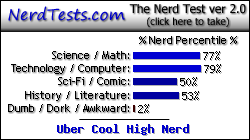
NerdTests.com says I'm an Uber Cool High Nerd.  Click here to take the Nerd Test, get nerdy images and jokes, and write on the nerd forum!

Bloggers' Rights

Bloggers' Rights at EFF